
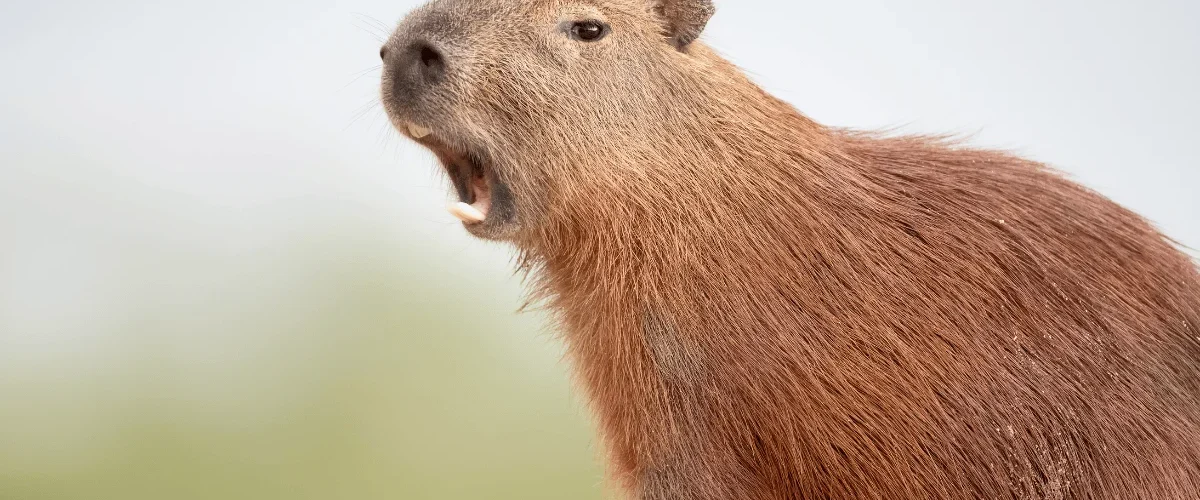
Picture this: You’re floating in a warm South American river. The sun is shining. A bird is sitting on your head eating flies out of your hair. A monkey is using your back as a hammock. Several turtles have decided you are their favourite rock. You weigh 66 kg, you have bright orange teeth, and you couldn’t care less about any of it. Meet the capybara — the world’s largest rodent, and quite possibly the most laid-back creature on the planet.
66
Maximum weight in kg
120
Length in centimetres
3
Kilograms of grass eaten daily
5
Minutes they can hold their breath
What Exactly Is a Capybara?
The capybara (Hydrochoerus hydrochaeris) is the world’s largest rodent (a mammal with ever-growing front teeth, like mice and squirrels). Scientists use a system called taxonomy (the science of classifying living things) to sort every creature into groups. Here’s where the capybara fits in:
| Classification Level | Capybara’s Group | What It Means |
|---|---|---|
| Class | Mammalia | Warm-blooded, breathes air, feeds milk to its young |
| Order | Rodentia | Front teeth that never stop growing — the biggest mammal group on Earth |
| Family | Caviidae | The guinea pig family — a capybara is basically a guinea pig that trained very hard |
| Species | Hydrochoerus hydrochaeris | Ancient Greek for “water hog” — extremely accurate |
Capybaras live across almost all of South America, from Colombia down to Argentina. You’ll find them wherever there’s water — rivers, swamps, marshes, and flooded grasslands. Their favourite spot is the Brazilian Pantanal, the world’s largest tropical wetland, which is roughly the same size as France.
A capybara’s scientific name means “water hog” in Ancient Greek. Their eyes, ears, and nose are all positioned very high on their heads — so they can stay almost completely hidden underwater while still being able to breathe, hear danger, and keep watch. Scientists call this a “periscope head”!
A Body Built for the Wetlands
Every single part of a capybara is quietly brilliant. Their coarse fur dries almost instantly after a swim. Their webbed feet work like flippers. And their bright orange teeth? Those are packed with iron, which makes the enamel (the hard outer coating of a tooth) incredibly tough — perfect for a lifetime of chewing tough grasses. The iron is also what gives them that distinctive orange-brown colour. Think of it like a built-in rust coating that actually makes the teeth stronger.
The capybara is basically proof that you can be very large, eat only grass, and still be the most popular animal at any party.
Capybaras can swim at up to 35 km/h in short bursts, and can hold their breath for up to five minutes — longer than most people. If a jaguar comes hunting on land, the capybara’s best move is simple: dive into the river and disappear.
Capybaras are coprophagous — which is a fancy science word for eating their own droppings. Specifically, soft pellets produced in the morning. It sounds revolting, but it’s actually brilliant: their digestive system only absorbs about half the nutrients from grass on the first pass. Eating it again lets them extract the rest. Rabbits do exactly the same thing. You’re welcome.
How Did They Get So Big?
Most rodents — mice, squirrels, hamsters — are small. So why is a capybara the size of a labrador? The answer involves evolution (the process by which living things slowly change over millions of years) and a very unusual piece of geography.
About 100 million years ago, South America broke away from Africa and became a giant, isolated landmass — almost like a massive island. The animals already living there, including early rodents, were cut off from the rest of the world for tens of millions of years. With fewer large predators and enormous amounts of tropical plants to eat, small animals had every reason to grow bigger. So they did.
Why Does Every Animal Love Them?
Here’s something the internet noticed before scientists fully explained it: every other animal seems to enjoy hanging out with capybaras. Monkeys ride on their backs. Birds sit on their heads. Turtles use them as floating platforms. Baby caimans (small relatives of the crocodile) have been photographed resting on top of them. Why?
The answer is symbiosis — a word scientists use to describe a close, ongoing relationship between two different species. Capybaras are involved in several types at once:
- Yellow-headed Caracara birds ride on capybaras and eat the ticks and flies from their fur. The bird gets a free meal — the capybara gets pest control.
- Smaller animals use the capybara’s loud bark as an alarm system. When it calls danger, everyone runs — including other species nearby.
- Turtles bask on top of a floating capybara to warm up in the sun. The capybara is unbothered.
- Baby caimans use them as a warm, stable resting platform near the water’s edge.
The deeper reason is simple: capybaras are extraordinarily calm. They almost never bite, they don’t chase animals away, and they rarely panic. Other species have learned, over generations, that being near a capybara is safe. Scientists call them a keystone social species — an animal whose calm presence holds an entire inter-species community together.
Capybaras and the Urban Invasion
In 2021, hundreds of capybaras moved into Nordelta — a luxury housing estate built on drained capybara habitat near Buenos Aires, Argentina. They ate garden plants, lounged in private swimming pools, and caused traffic jams. Residents complained. Wildlife biologists pointed out that humans had built houses on the capybaras’ ancient territory. The capybaras, seemingly unbothered, continued floating in the pools.
This is called urban-wildlife conflict — what happens when human development expands into wild habitats. It happens all over the world, from elephants raiding crops in Kenya to foxes exploring wheelie bins in the UK. You might even spot it closer to home: hedgehogs, bats, and peregrine falcons are increasingly making their homes in and around towns across the Channel Islands, adapting to the changes humans bring to their environment.
Capybara Q&A
Next time you’re walking along Jersey’s coastline or spotting wildlife at somewhere like Kempt Tower or Samarès Marsh, think about the extraordinary balance that keeps every ecosystem ticking — the alarm-callers, the pest-controllers, the grazers keeping vegetation in check. Every habitat has its version of a keystone species holding things together. The capybara just happens to do it while floating in a river with a monkey on its back, looking completely unbothered about the whole thing.