The Science of the Skies: April’s Celestial Alignment
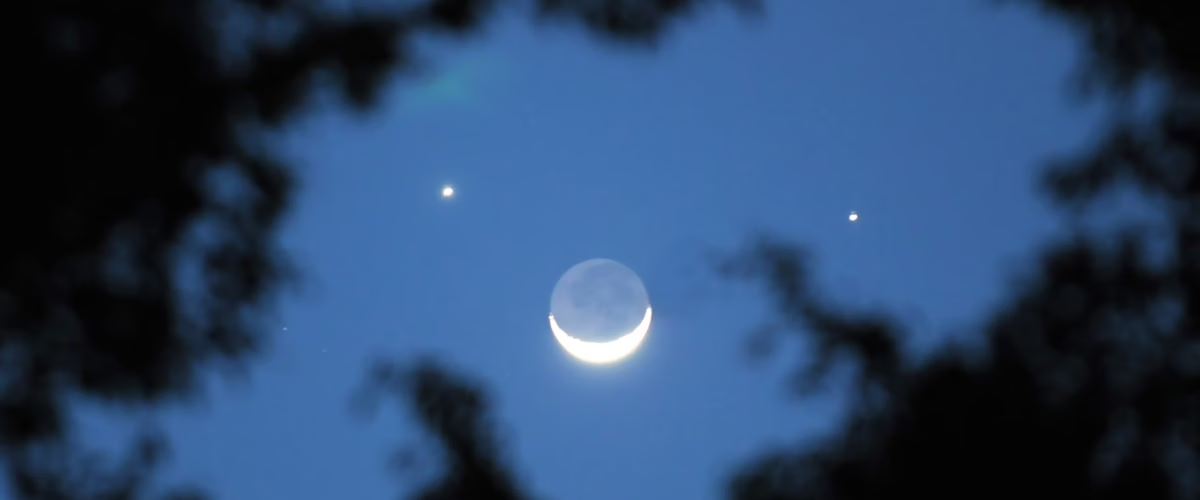
Recent weeks have witnessed a significant surge in astronomical interest, following the triumphant return of the Artemis II mission. This historic endeavour, which successfully facilitated a human journey around the Moon before splashing down safely, has reignited a passion for space exploration across the British Isles. However, the celestial theatre continues to offer more; this April, observers in Jersey are positioned to witness a “planet parade”—a phenomenon where multiple planets appear to cluster in the same region of the sky.
While some initial reports incorrectly suggested Jupiter would join the morning display, astronomers have clarified that the true pre-dawn lineup consists of Mercury, Mars, Saturn, and Neptune. This event illustrates the complex orbital mechanics of our solar system, where planets travelling at different speeds and distances occasionally appear to align from our specific vantage point on Earth. It is vital to understand that these planets are not physically close to one another in space; rather, this is an optical perspective caused by our line of sight across the ecliptic plane.
Why Geography Dictates Your View
Observation of this event requires careful planning, particularly due to Jersey’s specific geographic coordinates. Because the Channel Islands are situated at a northern latitude, these planets do not rise particularly high above the horizon before the Sun begins to illuminate the atmosphere. This creates a challenging “viewing window” where the planets must be spotted after they rise but before the morning twilight masks their faint light.
Jersey offers a distinct advantage for this observation: an unobstructed eastern sea horizon. Locations such as St Catherine’s Breakwater or the heights above Gorey are optimal. These sites allow skygazers to look directly across the water towards the French coast, ensuring that buildings or trees do not obscure the planets as they emerge from the horizon. This lack of “ground clutter” is essential when attempting to view Mercury, which remains notoriously close to the solar glare.
Fast Facts: The April Alignment
- The Participants: Mercury, Mars, Saturn, and Neptune.
- Peak Viewing Dates: 18th April through to 24th April.
- The Window: Between 05:30 BST and 05:45 BST.
- Location: Low on the eastern horizon.
- Top Spot: St Catherine’s Breakwater, Jersey.
Technical Challenges and Equipment
Successfully identifying all four planets requires more than just a keen eye; it demands an analytical approach to light and magnification. While Mars and Saturn may be visible to the naked eye under perfect conditions, their proximity to the horizon often causes “atmospheric extinction,” where the thickness of the Earth’s atmosphere dims their light. Consequently, using binoculars is highly recommended to enhance light-gathering capabilities.
| Planet | Visibility Level | Equipment Recommended |
|---|---|---|
| Mars | Moderate | Naked eye or binoculars |
| Saturn | Moderate | Naked eye or binoculars |
| Mercury | Difficult | Binoculars (due to solar proximity) |
| Neptune | Extremely Difficult | High-powered telescope only |
Neptune presents the greatest challenge to amateur astronomers. Unlike its closer neighbours, Neptune is far too distant and faint to be seen without significant magnification. To locate it, one must use a telescope and precise star charts to distinguish the planet from the surrounding background stars. The presence of the dawn glow further complicates this, as the increasing light quickly reduces the contrast necessary to see such a distant world.
A Critical Warning on Solar Safety
The narrow timing of this event necessitates a rigorous adherence to safety protocols. Because the planets are being “chased” by the rising Sun, the risk of accidental solar observation is high. If you are using binoculars or a telescope to sweep the eastern horizon, you must cease all observations the moment the Sun’s disc begins to emerge. Viewing the Sun through magnified optics, even for a fraction of a second, will result in immediate and irreversible optical damage. Scientific curiosity must always be balanced with the necessary precautions to protect one’s vision.
Ultimately, this planet parade emphasises the importance of patience and precision in science. While these alignments are relatively rare, they provide an excellent opportunity for students to engage with the mechanics of our solar system and practice the observational skills used by professional astronomers worldwide.